Image
Mitarbeiter vor Tastatur mit Glühbirne in der Hand

09.07.2026 | Blog Shadow AI in the enterprise: Why secure internal AI is essential

Employees are already using generative AI in their daily work. They draft emails, summarize documents, translate texts or look for better wording. In principle, this is a positive development: AI can make knowledge work noticeably easier. At the same time, risks arise when this usage bypasses IT, data protection and compliance.

TL;DR – Key Takeaways

✓ Generative AI has arrived in everyday business – shadow AI emerges when employees use publicly available AI tools because they need quick support and official alternatives are missing.

✓ The risk does not lie in AI usage itself, but in the lack of control over data, access rights, sources and traceability.

✓ Companies can reduce this risk with a central AI platform that is easy to use, incorporates internal knowledge and meets data protection, compliance and governance requirements.

Recent figures from the German Institute for Employment Research (IAB) show just how firmly generative AI has entered the corporate world: in 2025, almost 25 percent of companies in Germany were using generative AI; in 2023, the figure was only 5 percent. At the same time, 90 percent of AI-using companies relied on publicly accessible AI applications. Bitkom also reports that private AI tools are widely used in the work context in 8 percent of companies and used in individual cases in a further 17 percent.

This development makes one thing clear: shadow AI is not a marginal phenomenon. It is a sign that the demand for AI support is growing faster than the official offerings provided by many companies.

What Is Shadow AI?

Shadow AI refers to the use of AI applications within a company without official approval, technical control or organizational integration. Employees may use freely available chatbots or private accounts, for example, to complete tasks more quickly.

The problem is not the use of AI itself. On the contrary: generative AI in the enterprise can accelerate processes, make knowledge more accessible and relieve employees of routine tasks. It becomes critical when it is unclear which data is being entered, where that data is processed, whether it is stored and whether AI-generated results feed into decisions without being traceable and auditable.

Why Shadow AI emerges – and why it is risky for companies

Shadow AI rarely emerges from malicious intent. In most cases, it has a very practical cause: employees have specific tasks and are looking for quick support.

Anyone who wants to extract key facts from long documents, make a text easier to understand or structure a concept will often find instant solutions in freely available AI tools. If the company does not provide an equally simple alternative, a gap emerges between business needs and governance. This gap is filled by shadow AI.

Shadow AI is primarily a governance and security issue. Companies lose visibility into which AI tools are in use, what data is being input, and how results are generated:

  1. Particularly sensitive information includes personal data, contract content, technical documentation, pricing information, customer data or internal strategy papers. If such content is entered into unverified AI applications, data protection, compliance and security risks may arise. For example, an employee might copy a draft of a new contract into a public chatbot. Depending on the provider and configuration, that data could be stored, processed or used in ways outside the company’s control.
     
  2. In addition, many AI-generated answers appear plausible but are not automatically reliable. Without source references, document context or access-rights context, employees can find it difficult to judge whether an answer is correct, up to date and suitable for business decisions.

The Solution: A secure internal AI platform

Even if organizations communicate clear rules for the use of AI, train their employees and raise awareness of data protection risks, a strong internal AI offering is the best way to counter shadow AI. It must be secure, controllable and easy to use. Only if the official offering works smoothly in everyday tasks and provides real value will employees accept and use it.

A secure internal AI offering should cover the following areas:

1. General assistance tasks

Many AI use cases do not require internal company data. Examples include drafting texts, translations, summaries, comparing versions or developing ideas.

Here, the key question is: What happens to the data entered? Companies need a secure application in which employees can complete such tasks quickly and chat directly with a language model without transferring sensitive content to external services. Effective prompts, suitable micro-apps for recurring use cases and integrations into familiar working environments such as email or office applications are particularly user-friendly.

2. AI usage based on corporate knowledge – with access checks and source references

The situation becomes more complex when AI works with internal data. In this case, the challenge is not only data protection during input, but also access rights, sources and traceability

Employees want to find internal information, receive answers directly from knowledge repositories or continue and share chats later. Departments also need different role profiles, data sources and tones of voice. The legal department works differently from marketing, service or research and development.

An enterprise AI application must respect existing read and access permissions and ensure that employees only receive answers based on information they are authorized to access. Without access-rights context, AI may unintentionally expose information that is organizationally, contractually or legally protected, such as HR information, contracts, confidential project data or customer documents.

AI-generated results must also be verifiable. Source references show which documents, databases or knowledge repositories an answer is based on. They make it clear whether a statement is reliable or should be checked further in the source document.

Secure internal AI assistants therefore need to offer more than a general chatbot. They must bring together knowledge access, permission checks, source references and model usage.


Checklist: Requirements for an internal AI platform

• User-friendly AI usage for general assistance tasks
• Data-protection-compliant processing of entered content
• Access to corporate knowledge with permission checks
• Source references for traceable answers
• Role profiles and department-specific assistants
• Integration into existing working environments
• Central control instead of isolated point solutions

The hidden cost trap: Shadow AI is more expensive than It seems

Introducing a central AI platform is primarily an investment in risk reduction and operational efficiency. The real costs of shadow AI are rarely found in license fees, but in latent liability and administrative overhead:

  • Compliance risk: Every uncontrolled chat can become a contract or data protection issue. The potential costs of warnings, legal disputes or reputational damage can be far higher than the cost of a central license.
  • Audit overhead: A central platform enables continuous logging and traceability. This eliminates much of the manual effort involved in sporadic audits and significantly simplifies compliance with internal and external requirements.
  • Operational efficiency: Tool sprawl and fragmented solutions lead to inefficiencies in knowledge usage and a lack of scalability. A standardized platform bundles resources, reduces redundancies and enables consistent governance, securing the ROI of AI initiatives.

A central platform can quickly pay for itself by reducing these hidden risks and significantly lowering administrative effort.

What companies should do now

Many companies initially respond to AI demand in a fragmented way. One department uses AI for text drafts, translations and similar tasks, another tests AI for customer inquiries, and a third experiments with chatbots on internal data. This can help in the short term, but it often creates new tool sprawl.

Strategically, a central and attractive internal AI offering is the better approach. It combines prompting, work with corporate knowledge, source references, assistants, model selection, data security and governance. IntraFind is an example of this approach: secure internal AI assistants that centrally bring together corporate data, permissions and a GDPR-compliant architecture.

In addition, companies need clear guidelines for approved tools, permitted data, review steps, labeling and responsibilities when working with AI-generated results.

Conclusion: using AI without taking unnecessary risks

The gap between employees’ need for quick support and the often missing technical infrastructure is the driver of shadow AI. Successful companies recognize AI as a practical tool and integrate it into their processes with the right safeguards.An internal AI platform offers the best compromise: it gives employees the support they are looking for and gives IT the security it needs.

FAQ

Shadow AI is the use of AI tools within a company without official approval, technical control or integration into data protection, compliance and IT governance processes.

Bans do not resolve employees’ need for support. If generative AI helps in everyday work but no secure internal alternative is available, private tools will remain attractive.

An internal AI platform can do more than chat with an LLM. It also incorporates internal data sources when completing tasks. In doing so, it protects corporate data, takes existing permissions into account, provides source references and can be integrated into existing work and knowledge systems. It can be operated either on premises or in the cloud.

Related articles

Image
Laptop mit Chatbot und Antwort in Sprechblasen

iAssistant at work

The key question is whether an assistant is genuinely useful in everyday work. That is precisely the purpose of the IntraFind iAssistant: a RAG-based AI assistant designed to deliver reliable answers and transparent sources, enabling productive knowledge work on your own company data – securely and in full GDPR compliance.
Read blog
Image
iFinder Enterprise Search

Enterprise Search with Chatbot and RAG explained

Enterprise Search makes information within organizations and government agencies discoverable. Internal AI assistants leverage this foundation to formulate reliable answers and summaries. This article explores how these two approaches complement each other: from data integration and RAG to security and governance
Read blog
Image
New: iHub

IntraFind launches new GenAI tool

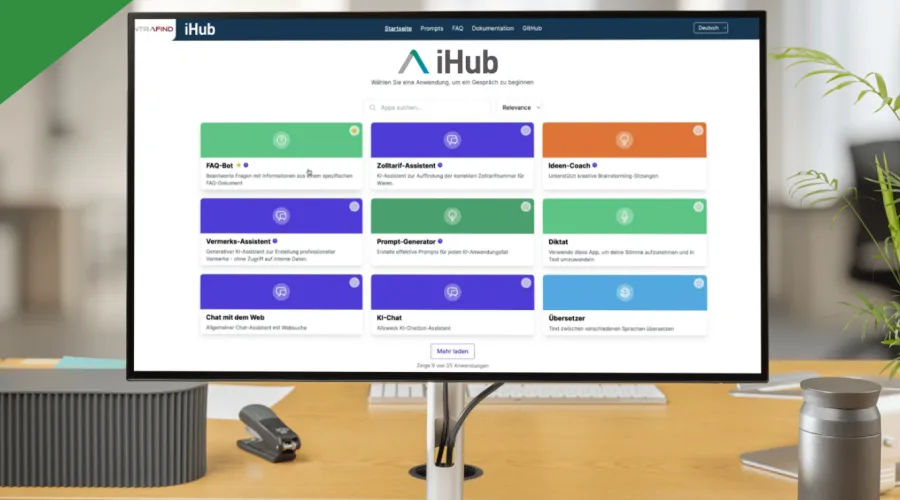
IntraFind has added a new GenAI tool to its iFinder software. Alongside the iAssistant for querying corporate data, IntraFind now provides the iHub. This allows users to handle everyday tasks—similar to those done with public chatbots like ChatGPT or Perplexity AI—in a secure, controlled environment
Read news

The author

Franz Kögl
CEO
Franz Kögl co-founded IntraFind Software AG with Bernhard Messer in 2000. Together, they built the company into an established provider of enterprise search software. He regularly gives talks and writes specialist articles on topics such as artificial intelligence, machine learning, and cognitive search.
Image
Autor Franz Kögl IntraFind