Image
Lupe mit Blick auf vernetzte Linien

18.12.2025 | Blog Why AI-based search is essential for corporate chatbots

Generative AI in business? Sounds promising – but often fails due to data issues.
Only when unstructured information is processed intelligently can chatbots deliver truly accurate answers. Fortunately, companies don't have to do this themselves: modern AI-based search software does all the work – from understanding and finding to providing the right answer.

From a few PDFs to millions of documents: where AI reaches its limits without search

Some companies start their journey into the world of generative AI with a clearly defined goal: upload a few PDFs, ask questions about them, and get answers. For this manageable application, you can make the information directly available to the language model or an AI platform such as iHub in a protected environment and quickly get good results.

The challenge arises with larger and, above all, heterogeneous data sets: long documents, different formats, organically grown folder structures, missing metadata, scattered sources. As soon as companies need answers from a complete file share, archive, wiki, emails, or SharePoint with millions of documents, for example, simply providing the documents reaches its limits. This is when more powerful tools are needed: AI-based search software that first identifies the relevant documents in this enormous, heterogeneous database and then makes the right content findable within them – figuratively speaking, identifying the relevant documents and locating the proverbial needle in the haystack.  At the same time, it converts unstructured data into structured information and provides the chatbot with exactly the content it needs to answer questions. 

So what is unstructured data?

What is unstructured data?

Unstructured data is information that does not follow a fixed pattern and therefore cannot be directly read or categorized by systems. It accounts for over 80% of all data in many companies. Typical examples include PDF or Word documents without defined fields, scans and images (e.g., invoices as photos), emails and presentations, CAD and design files, content from intranets, wikis, or websites.
Unstructured does not only mean "technically disordered," but often heterogeneous in terms of subject matter: Data comes from different areas such as law, finance, or technology—each with its own document types, terms, and formats. Not all PDFs are the same. This mixture makes automatic indexing even more difficult.
The solution: AI-based enterprise search that turns unstructured information into structure, context, and usable knowledge and is capable of accessing information from heterogeneous specialist areas.

Unstructured data in companies: Why it is the biggest challenge for GenAI

Almost every company has millions of unstructured files – spread across PDFs, Word documents, emails, presentations, images, CAD files, and website content. This data is mostly unstructured, with little or no consistently maintained metadata, from a wide variety of departments, spread across different systems. These files often contain important information that cannot be found or used directly.

What does this mean in concrete terms? Three typical examples from practice:

  • Screenshots or scans of invoices: The information (date, amount, invoice number) is there – but as an image.
  • Versions in file names such as "Presentation_Hanover Fair_V1_final_pptx": These contain valuable version or context information that cannot be read directly from the file content.
  • Folder structures in the file system: These often indicate whether a document originates from a specific company department or belongs to a specific project, for example – but the information is contained in the path, not in the document itself.

These examples show that the information is available, but the company cannot use it due to its lack of overarching context and its diversity. This is exactly where intelligent enterprise search comes in. It transforms unstructured and technically diverse content into contextualized information that can be efficiently searched and processed.

The key: creating structure with AI-based enterprise search

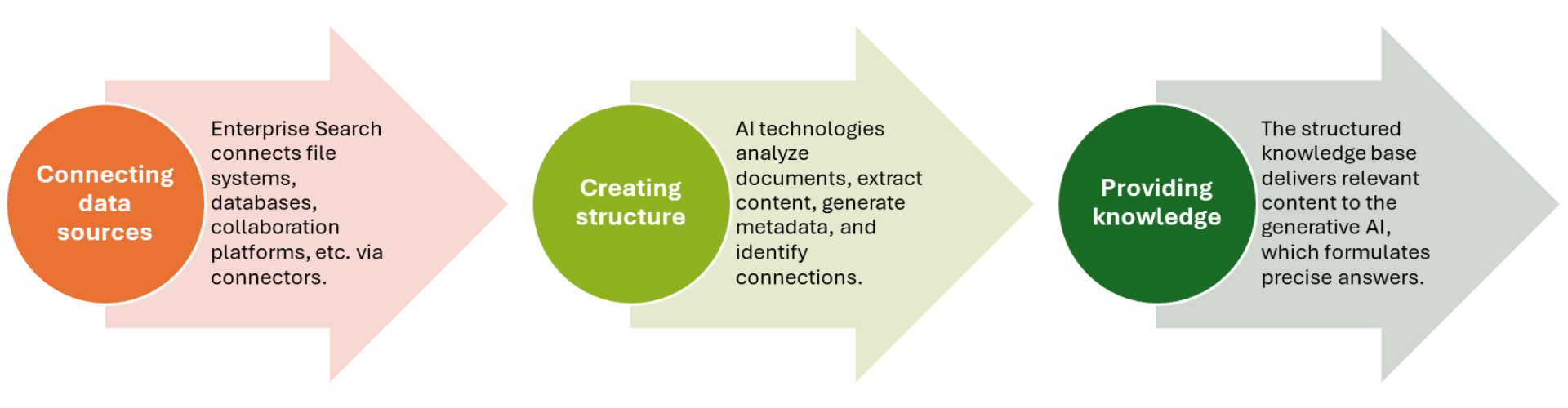
Modern AI-based search systems such as iFinder combine classic information retrieval methods with AI to not only search unstructured data, but also enrich it intelligently and chat with the company's own information without distortion. In the process known as enrichment,

  • content is extracted (e.g., from PDFs, images, scans),
  • enriched with metadata (e.g., author, date, topic),
  • and classified (e.g., category, document type, project reference).

Today, this is no longer done using complex manual pipelines, but rather via AI-supported processes with LLMs, multimodal and specialized extraction models.

A real-life example shows how powerful this effect is in practice:  A customer submits 30,000 records of stock purchases as screenshots. An AI system recognizes the relevant values (date, price, number), extracts them, and makes them searchable and filterable.

The advantage: Companies do not have to prepare their data manually. The search software takes care of this – standardized, automated, without extra coding. This creates a structured database that recognizes correlations and serves as a reliable basis for generative AI.

Graphic: From data flood to answer: How enterprise search makes knowledge usable for AI
Without quality-assured information, AI remains blind

A common misconception is that you can throw "everything" into an AI system and expect magical answers. In practice, however, it has been shown that even the best generative AI cannot deliver reliable results if unstructured data is processed unprepared. The result can be "garbage in, garbage out."

Effective systems therefore rely on clever preprocessing: scattered data is turned into usable knowledge building blocks – quickly findable, contextualized, and searchable.

Conclusion: Structure is the basis for precise answers

Semantically structured and indexed content is easy to generate today. AI-based search software such as iFinder takes care of all the preparation and information retrieval and, in combination with the generative AI assistant iAssistant, provides a powerful tool that combines search and chatbot functions on a reliable database.


Related articles

Image
Leuchtende Glühbirne in kräftigen Farben

RAG is dead - or is it?

Retrieval-Augmented Generation (RAG) was introduced to address the limitations of LLMs. But with larger context windows and improved training methods, some claim RAG is becoming obsolete. In this blog post, we explain why RAG is far from dead
Read blog
Image
Eisberg über und unter Wasser

AI assistant with company data: make or buy?

An increasing number of organizations are looking to use generative AI to interact with their own data, expecting it to significantly boost efficiency. After conducting research, they have determined that Retrieval-Augmented Generation (RAG) is the best solution. This raises the classic “make or buy” question for IT departments. Some tips.
Read blog
Image
Wegweiser, die in verschiedene Richtungen zeigen

Why context is crucial for effective enterprise search

What makes a good enterprise search? It ensures that users quickly find the information they need for their work. To retrieve truly relevant information from large, diverse data sources, it is crucial that the search takes context into account. This is also the basis for obtaining helpful results from generative AI.
Read blog

The author

Daniel Manzke
Head of Engineering
Daniel began his career in document and knowledge management, where he integrated and utilized enterprise search software from IntraFind early on. Over the past 10 years, he founded his own AI company and, as CTO in the start-up and financial sectors, was responsible for innovative products and software solutions. Today, as Head of Engineering at IntraFind, he passionately leads the further development of iFinder with expertise.
Image
Daniel Manzke