
Trusted by Design: Sovereign, Permission-Aware, and Secure
Permission Checks as the Foundation for Trustworthy Enterprise AI
The most common reason enterprise AI projects get stuck in the pilot phase is not model quality – it is the concern that a language model might disclose information the user asking the question should never have been allowed to see.
The IntraFind Enterprise AI Platform addresses this problem at the architectural level:
Access rights are inherited from the source systems and enforced at every step – in the result list as well as in filters, autocomplete suggestions, document previews, the text passages passed to the language model, generative answers and every agent step.
What Is Grounded Generation?
Grounded generation means: answers are generated exclusively from authorized enterprise sources – with traceable source citations down to passage level.
A user asks a question in natural language. The system finds matching passages in the enterprise index. Only passages the user is authorized to access are passed to the language model as context.
The model generates the answer exclusively on this basis. The answer includes citations down to document and passage level. Two employees, the same question – two answers, each precisely within their own permission scope.
The difference from an ungrounded answer based on general model knowledge: such an answer may sound plausible, but it is not backed by evidence. Grounded generation makes every statement verifiable, authorized and auditable – and significantly reduces the risk of hallucinations.
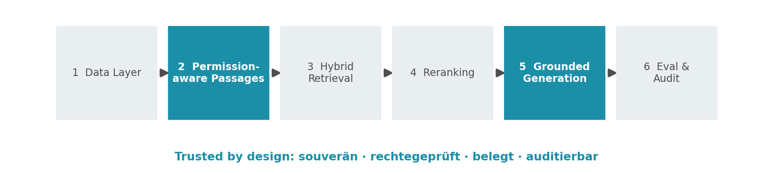
Six Stages That Build Trust
1 – Data Layer. Sources, connectors, documents, metadata, permissions and vectors reside in one controlled layer. Access rights are applied through early binding during indexing – including permissions inherited from folders, groups and roles. There is no intermediate state in which unauthorized hits exist and “merely” have to be hidden.
2 – Permission-aware Passages. Permission checks apply at passage level: users only see context they are allowed to see – in hits, filters, autocomplete, previews, the LLM context and agent steps. When sources are combined, each passage is checked against its own source system; one source cannot override the permissions of another.
3 – Hybrid Retrieval. Full-text, linguistic, metadata, semantic and vector search are combined – for precise results even with specialist terminology, synonyms and multilingual content.
4 – Reranking. The most relevant passages are prioritized from the hits before they are passed to the language model – the quality of the context determines the quality of the answer.
5 – Grounded Generation. The language model answers exclusively on the basis of verified passages – with citations down to the passage.
6 – Eval & Audit. Groundedness, citation quality and retrieval accuracy are evaluated and models are compared; logs, user feedback and the audit trail make every answer traceable – including the steps taken by AI agents. This provides the accountability that internal audit, data protection and information security require.
Conclusion: Not “just another RAG”, but a controlled architecture: sovereign, permission-checked, evidence-based and auditable – and therefore more production-ready than generic assistant approaches.
💡FAQ - Enterprise Search AI Platform
Permissions are continuously synchronized with the content; changed or revoked rights take effect in search, answers and agents with the next synchronization.
Copilot and ChatGPT Enterprise are productivity assistants tied to their respective ecosystems. The IntraFind platform is the permission-checked knowledge layer across all your sources – including those outside Microsoft 365 – and can supply these assistants with enterprise context via MCP instead of replacing them.
No. Only passages that the requesting user is authorized to access are passed into the model’s context.
Yes. Every request – whether from iFinder, iAssistant, an agent or a third-party assistant via MCP – is checked against the permissions of the logged-in user.
Queries, the sources used and agent steps are logged and auditable.
Secure, Sovereign, Compliant
✔️EU AI Act - The Enterprise AI Platform complies with the AI Act (Regulation (EU) 2024/1689)
✔️Data protection - GDPR-compliant operation
✔️No model training - Your data is not used to train AI models
✔️Data residency - You decide where your data is processed and stored
We Look Forward to Hearing from You
Bring us a specific use case – a search that takes too long, a question you want a chatbot to answer, or a process an agent could take over.
We’ll show you how to build it on the platform – and what becomes possible next without starting over.


