Agent Washing: When suddenly everything is an AI agent
From chatbots and digital assistants to automation solutions, almost every AI application today seems to be marketed as an “agent.” Yet in many cases, there is little genuinely new behind the label. A chatbot that accesses documents or performs a specific task using a predefined prompt is not automatically an AI agent.
This phenomenon is known as “agent washing.” According to a Gartner assessment from June 2025, of the thousands of vendors marketing agentic AI, only about 130 actually possess the corresponding capabilities. Gartner also predicted that by the end of 2027, more than 40 percent of Agentic AI projects could be discontinued—due, among other things, to rising costs, unclear business value, and inadequate risk controls.
Yet the interest in AI agents is certainly justified. They promise not only to provide information but also to take on tasks independently. Instead of developing increasingly complex AI systems, however, companies should first ask themselves which tasks they actually want to automate—and how much autonomy the AI needs to do so.
AI Assistant, Workflow, or Agent: What’s the difference?
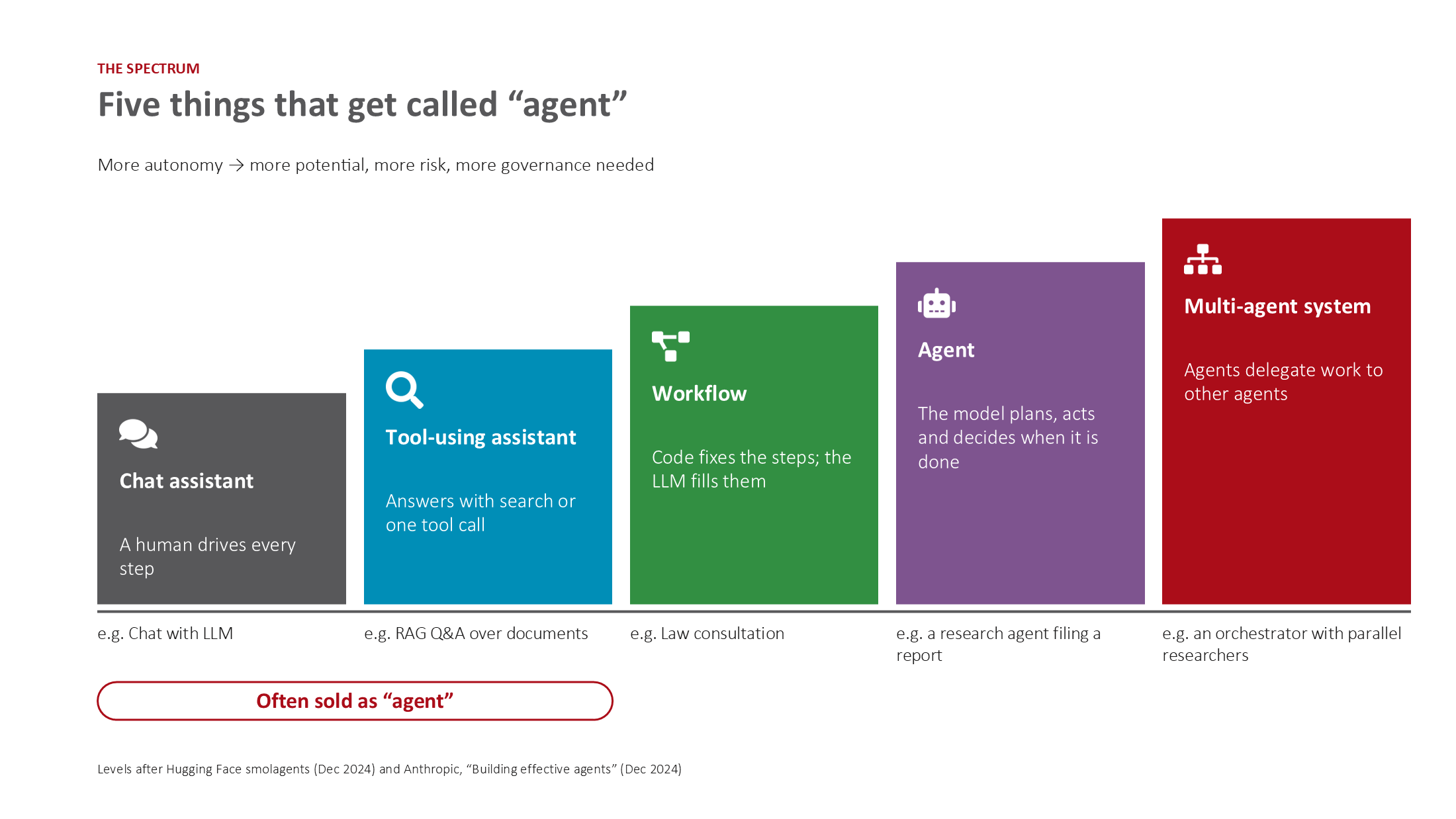
The boundaries between the various AI applications are not always clear-cut. However, one key criterion helps with practical classification: Who controls the work steps—a human, a predefined process, or the AI itself?
- AI Assistant: Helps users with individual tasks, such as answering questions, summarizing documents, or drafting content. Even if the assistant accesses internal data or external tools, control essentially remains with the human.
- AI Workflow: Automates multiple work steps in a defined sequence. Individual steps may be supported by a language model, such as during the classification or extraction of information. The workflow itself, however, is largely predetermined. The advantage is greater control and traceability: it is easy to track which steps were executed and when.
- AI Agent: Pursues a specified goal and decides independently, within defined limits, which steps are necessary to achieve it. It can interact with other systems, review the results of its actions, and adjust its next steps accordingly. The advantage: Users do not have to initiate every step.
That said, assistants and workflows are by no means less valuable than agents. Off-the-shelf AI apps, for example, can provide proven prompts for recurring tasks. This allows even employees without specialized prompting skills to use AI effectively in their day-to-day work.
Why controlled workflows are often still the better choice
Just because an agent can technically manage a process does not mean it is necessarily the best solution.
Especially in companies and government agencies, processes must function reliably, results must be traceable, and sensitive information must be protected. If all steps are controlled by a language model, the behavior becomes less predictable. After all, generative AI does not necessarily produce the same results every time it runs.
A clearly defined workflow offers advantages here: For each step, it is possible to determine what information is processed, what task the AI takes on, and what result is expected. Critical decisions can be flagged for human review.
Our experience from customer projects suggests that controlled AI workflows are often the better starting point. The pragmatic approach therefore frequently leads from AI assistants through controlled workflows to increasingly autonomous agents. First, the AI is tested to see if it can reliably perform individual tasks. These steps are then linked together and automated. Only once the process has been sufficiently tested is the AI granted greater autonomy.
The greatest added value does not necessarily come from maximizing autonomy, but rather from a sensible combination of automation, reliability, control, traceability, and human expertise.
Real-world example: Systematically analyzing hundreds of consultation submissions
A project in the public administration sector implemented by IntraFind demonstrates how such an approach works.
During the legislative process, submissions from associations, institutions, and other stakeholders must be reviewed and evaluated. These submissions are contained in various documents and often address multiple legislative provisions. Evaluating them manually is therefore time-consuming.
An AI-powered workflow supports this process in four steps:
- Indexing documents: The submitted comments are made accessible via an enterprise search solution.
- Analyzing content: The AI identifies which legislative provisions a submission refers to, what changes are proposed, and how those changes are assessed.
- Consolidating results: The information is grouped by topic and linked to the respective source documents.
- Expert review: The responsible staff members review and evaluate the results. Final responsibility remains with human decisionmakers.
The process described is a controlled AI workflow, not an autonomous agent system. In the future, it could be expanded to include agent-based functions: For example, an agent could detect new submissions, update the relevant analyses, and notify the responsible staff members.
This example demonstrates that reliable workflows can form the foundation for increasingly autonomous processes. This approach can also be applied to document-intensive processes in companies, such as handling customer inquiries or analyzing extensive business documents.
Autonomy requires control and traceability
An AI agent that independently accesses information and performs actions in enterprise systems requires more than just a powerful language model. Four requirements in particular are crucial for safe and productive use:
- Clear permissions and boundaries: What information is the agent allowed to view, what actions may it perform, and when is human approval required?
- Traceability: Which sources did the agent use, which steps did it take, and what results did it achieve? Actions must be logged accordingly.
- Continuous quality assurance: Defined test cases and reference results (golden datasets) help detect changes in AI behavior early — for example, following model or software updates.
- Cost control: Limits on model calls, computational effort, and runtime prevent autonomous processes from consuming a disproportionate amount of resources.
This is particularly essential for business-critical or regulated processes. After all, autonomy without evaluation and governance creates additional risks.
Multi-Agent systems: More possibilities, but also more complexity
Multi-agent systems take this a step further. Here, multiple specialized agents collaborate to achieve a common goal. For example, a coordinating agent can assign tasks while others research information, analyze results, or critically review them.
Such architectures open up interesting possibilities, particularly for complex research or development tasks. However, they also present additional challenges: information must be exchanged between agents, partial results must be consolidated, and errors must be detected. Added to this are higher computational costs as well as additional effort required for coordination and quality assurance.
Therefore, more agents do not automatically mean better results. For many business applications, a manageable workflow or a single specialized agent is likely to be the more cost-effective and reliable solution initially.
Without a reliable knowledge base, even the best agent remains limited
Amid all the discussion about models, agents, and automation, one essential prerequisite is easily overlooked: the information that the AI works with.
Over the years, companies have stored and archived large volumes of documents. These contain valuable knowledge that must first be made accessible for AI applications. However, this information is usually scattered across file shares, document management systems, SharePoint, emails, or business applications.
A powerful enterprise AI platform connects to these diverse data sources and makes relevant content accessible to AI applications. It is crucial that existing access rights are respected. An agent must not automatically have access to all company information simply because it is technically capable of doing so.
This is precisely where IntraFind’s Enterprise AI Platform comes in: iFinder makes knowledge distributed across enterprise systems accessible while respecting existing read access permissions. AI assistants such as iAssistant and AI applications in iHub build upon this foundation. Through appropriate interfaces, the knowledge base can also be utilized for custom agents and applications.
This creates an important foundation for the secure and productive use of AI agents.
Conclusion: Master the process first, then increase autonomy
AI agents have significant potential to optimize workflows. But not every application marketed as an agent actually operates autonomously. And not every task benefits from an autonomous system.
The most sensible approach often involves clearly defined use cases: first, test individual AI functions; then, establish controlled workflows; and, if the benefits warrant it, selectively add agent capabilities. Reliable access to information, clearly defined access permissions, traceable processes, and human oversight form the foundation for this.
What matters is not how many agents a company deploys, but which tasks they can perform reliably, securely, and cost-effectively.